Non-perturbative quantum field theories
The non-perturbative study of relativistic quantum field theories is required for the theoretical understanding of many phenomena in Physics where the interactions among the fundamental constituents are strong. We actively involved in the following areas of research:
The anomalous magnetic moment of the muon
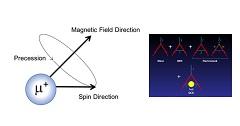
The current discrepancy between the theoretical prediction and the experimental measurement of the anomalous magnetic of the muon, is a promising direction to look for physics beyond the Standard Model. The theoretical determination of the hadronic contributions, which dominates the error of the theory prediction, is based on dispersive relations and rely on several additional experimental inputs. Lattice QCD is the only method to obtain a first-principles prediction and our group is pioneering a calculation of the hadronic vacuum polarization contribution to the (g-2) of the muon based on a new multi-level Monte Carlo method, with the aim of delivering the desired target accuracy of a few per-mille.
Lattice QCD and flavour phenomenology
CP violation in the SM is not sufficient to explain the observed matter/antimatter asymmetry. Hence CP violating hadronic decays and other flavor-physics related processes are an excellent laboratory to test the validity of the SM, to possibly identify discrepancies and signs of unknown fundamental phenomena. The prediction of the relevant hadronic amplitudes can be reliably obtained only from Lattice QCD simulations. In our group we are working both on their direct calculation using the so-called finite volume formalism, and on the formulation of new formal strategies to extract them from Euclidean correlators.
The physics of the quark-gluon plasma
QCD plays a crucial and dominant role in phenomena involving the collective behaviour of strongly interacting particles that span from astrophysics and cosmology to the collisions of heavy ions. However, the behaviour of the theory is unknown for temperatures above 1-2 GeV due to numerical challenges. Our group has proposed and developed an innovative theoretical framework that overcomes the difficulties of state-of-the-art approaches to investigate QCD at high temperatures. The setup is based on formulating the quantum theory in a moving reference frame in the path integral formalism, thus providing new and more efficient equations to compute non-perturbatively the thermodynamical properties of the theory by Monte Carlo simulations on the lattice. The method has been already successfully applied to compute the Equation of State of the SU(3) Yang-Mills theory to very high temperatures and we are currently extending the study to QCD; the technique has been also instrumental to measure, for the first time, the QCD mesonic screening masses at temperatures up to the Electro-Weak scale and beyond. In both cases, despite perturbation theory being expected to be valid at asymptotically large temperatures, it turns out that it does not provide a satisfactory description of thermal QCD up to the electroweak scale.
Contacts
Funding
- [2021-2023] QCDLAT, INFN national project
- [2021] MLHVP - Multi-Level measurement of the Hadron Vacuum Polarization in Lattice QCD, PRACE
- [2019-2020] EoSQCD – Equation of State of QCD, PRACE
- [2019-2020] The Equation of State of QCD, ISCRA
- [2019-2020] The anomalous magnetic moment of the muon with a multi-level algorithm, ISCRA
- [2019] Gradient Flow coupling in a massive scheme, HLRN
- [2018-2020] New frontiers in lattice field theory for the SM and beyond, INFN national project
- [2016-2018] High performance data network, INFN special project
External resources
Scientific divulgation
- The Standard Model and a new algorithmic invention to measure the specific properties of one of its fundamental particles - the muon
- Magnetismo anomalo del muone: una sfida per la prossima generazione di supercalcolatori
- Destra o sinistra, che direzione scelgono i quark? Ce lo dice il super computer
- Destra o sinistra: è un supercommputer a dirci la direzione che prendono i quark
- New Calculation Refines Comparison of Matter with Antimatter